The Designer Did Not Get Replaced. The Designer Got Promoted.
7 September 2026 | By Anirudha Kadam, Founder, Autofocuss Marketing
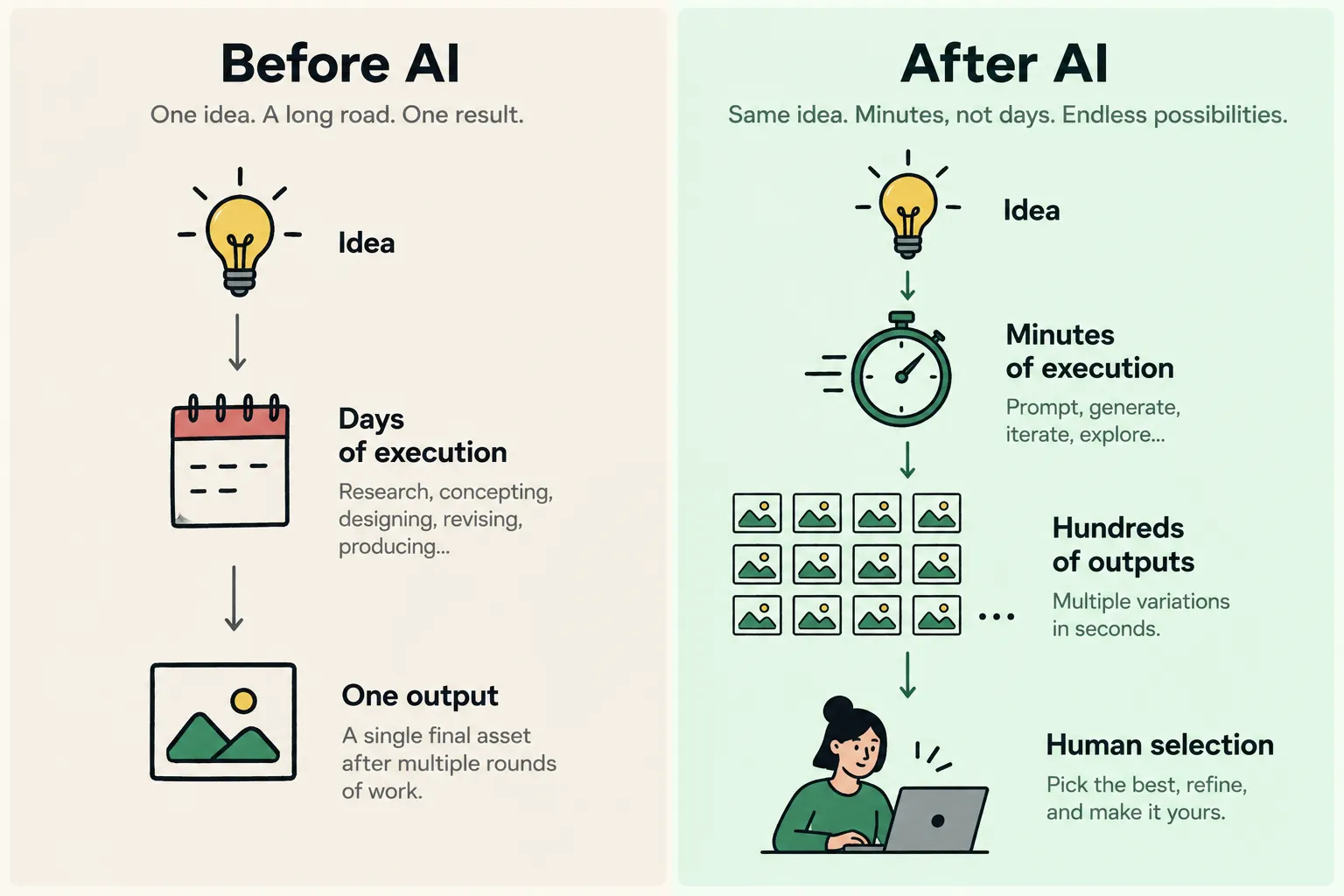
Here is the short version. AI did not take the graphic designer’s job. It took the graphic designer’s hands. What is left is the part that was always the actual job: deciding what deserves to exist.
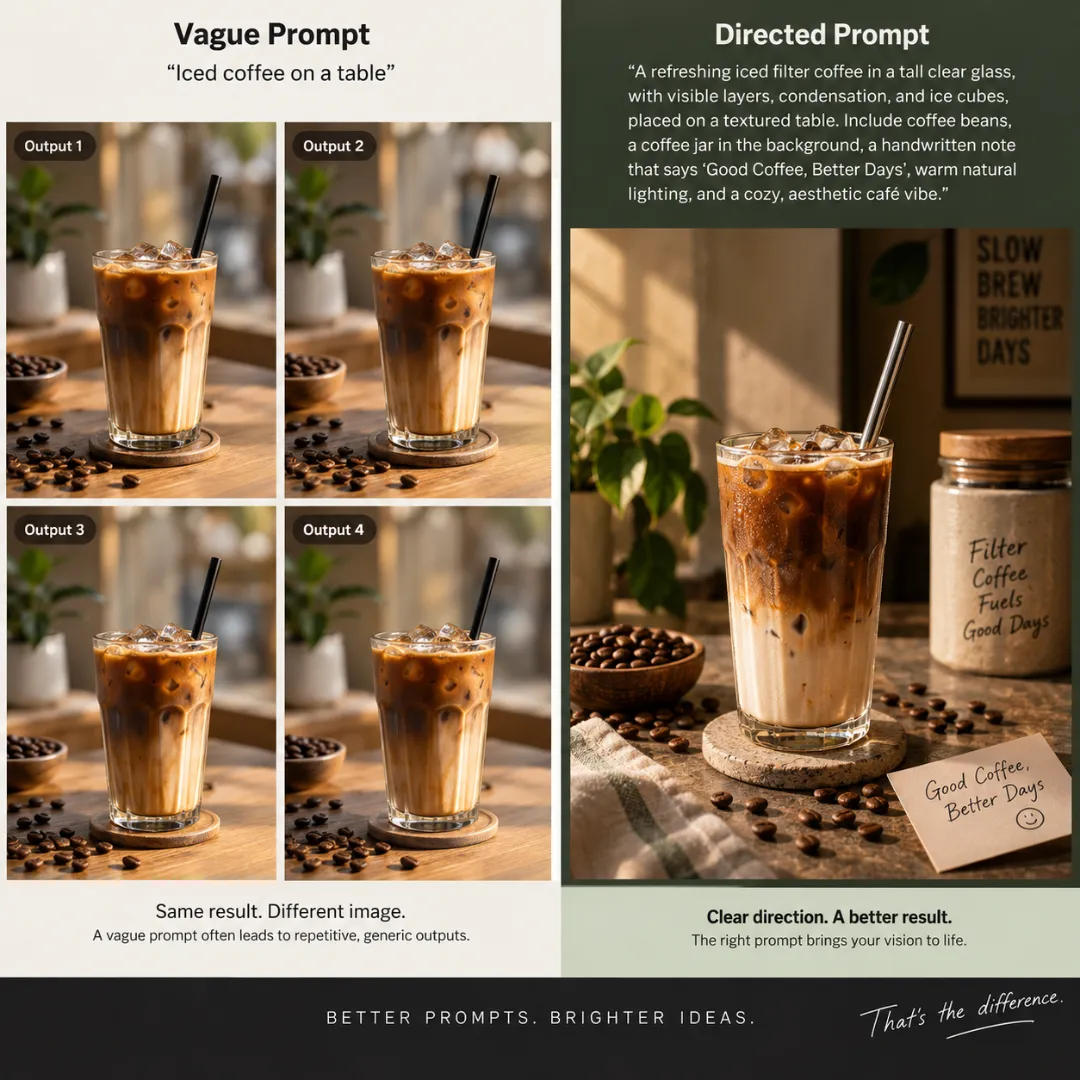
The designers who understood this in 2024 are now doing in an afternoon what used to take a week. The ones who did not are typing “create me a social media post for a coffee shop” into a box and wondering why every output looks like every other output on the internet.
Both groups are using the same tools. That is the whole story.
What is an AI director in design?
An AI director is a designer whose primary output is judgment rather than execution. They define the idea, the constraints, the reference, the visual language and the brief, then use generative tools to produce and iterate variations at speed. They still make every consequential decision. What changed is that the decisions now happen faster and there are more of them.
The old designer answered the question “how do I build this?” The AI director answers “what should exist, and is this version of it good enough to ship?”
The data: adoption is high, but trust is not
The gap between “designers use AI” and “designers trust AI output” is the most useful number in this whole conversation.
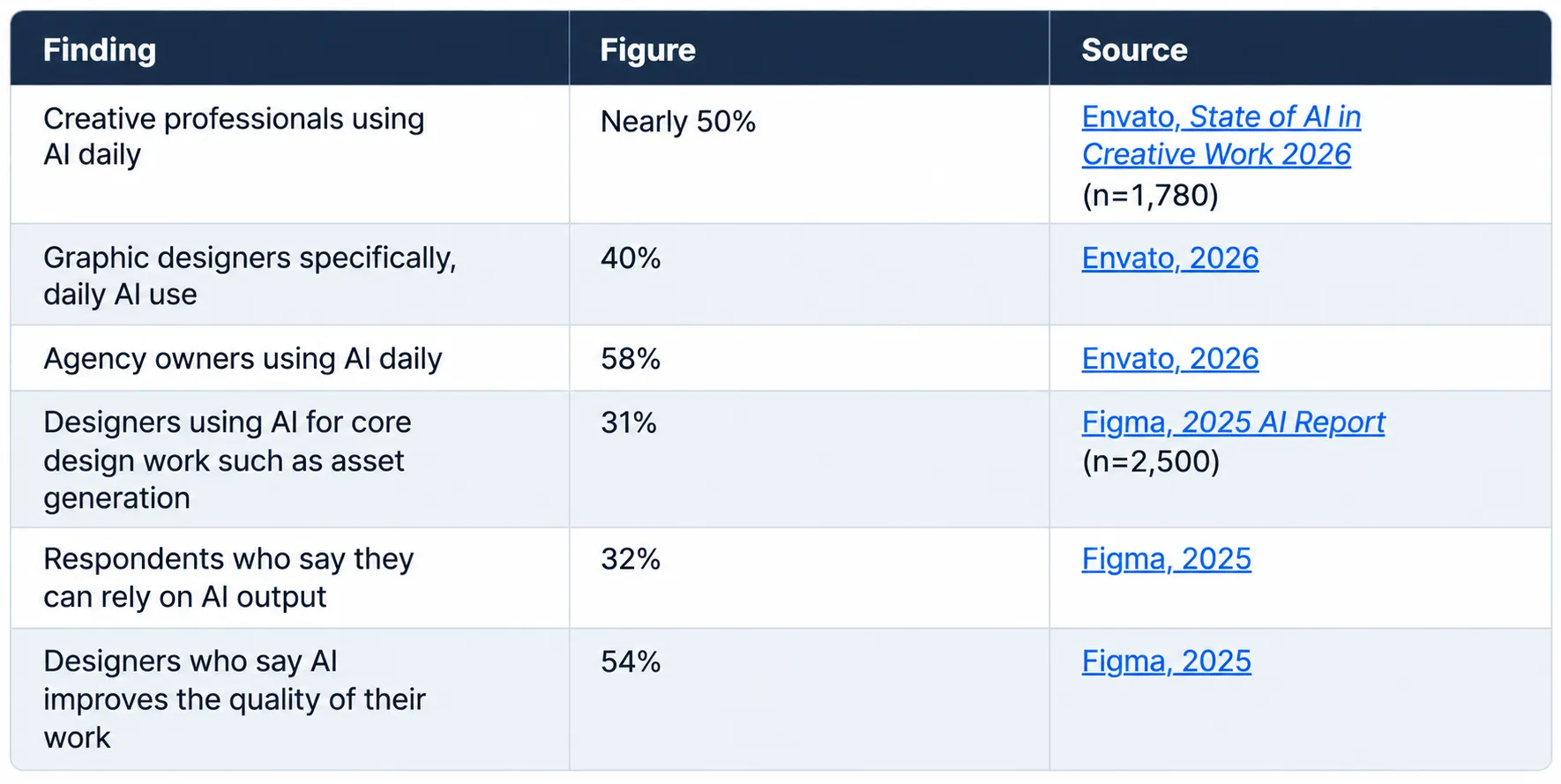
Read those last three rows together. Roughly a third of designers put AI into core production, only a third trust the raw output, and just over half say it improves quality. That is not a picture of replacement. That is a picture of a tool that produces a lot of material of which a human then throws most away.
Envato’s own summary of how professionals actually use it is blunt: for “rough cuts, mockups, placeholders, and idea starters, not polished final outputs.”
The takeaway: AI has become part of the design process, but it is not at the front of it. The brief is still at the front.
Why one prompt produces generic work
There is a real, measured reason that “make me a post for XYZ” produces something everyone recognises as AI.
A study published in Science Advances in July 2024 by Anil Doshi (UCL) and Oliver Hauser (University of Exeter) tested this directly on creative writing. Writers given AI ideas produced work judged more creative individually. But across the group, the stories became measurably more similar to each other. Individual creativity went up. Collective diversity went down.
Their conclusion, in the researchers’ words, was a warning about “a social dilemma”: everyone gets better output, and everyone’s output converges. (Science Advances, 2024 | University of Exeter summary)
That is exactly what is happening on your feed right now.
A generative model is trained to return the statistically most probable answer to your prompt. If your prompt is generic, the most probable answer is the average of everything that has ever been made for that brief. Average is, by definition, the thing nobody remembers.
This is why your client’s audience can spot it without knowing anything about AI. They have seen that gradient. They have seen that impossibly symmetrical face. They have seen that lighting. They cannot name what is wrong. They just scroll.
The two ways brands are using this, and the results
Case 1: AI as the idea (works)
In 2022 Heinz and agency Rethink asked DALL·E 2 to draw “ketchup.” It drew a Heinz bottle. Again and again, in every style they tried, from renaissance painting to street art. They turned that into the campaign itself: A.I. Ketchup. The AI made the images. The idea that the AI’s bias was the proof of brand dominance came from humans, and that idea is what won awards and earned coverage. (Ads of the World | LBBOnline)
Case 2: AI as the labour, human as the director (works)
In June 2025 an ad for Kalshi aired during the NBA Finals. It was made with Google Veo 3 by filmmaker PJ Accetturo for under $2,000, in two days. The number that matters is buried in the coverage: he generated 300 to 400 clips to keep 15. (NPR)
That is a roughly 4% keep rate. The value he added was not the generating. It was the 96% he threw away, plus the script, the casting logic, the edit and the music. His own line on it: “Just because this was cheap doesn’t mean anyone can do it.”
Case 3: AI as a cost-saving shortcut (does not work)
Coca-Cola ran an AI-generated Christmas ad in 2024 and got significant backlash. It ran another one in 2025 and got backlash again, with the work widely described in coverage as “AI slop.” (NBC News, 2024 | Forbes, November 2025)
One of the largest advertisers on earth, with unlimited access to tooling and talent, produced work that got rejected twice. Not because the tools were bad. Because the output read as a substitution for an idea rather than the expression of one.
Coca-Cola | Holidays Are Coming Disney approved our insane AI Kalshi ad to run during the NBA Finals 🤣
Generic prompting vs directed AI: what actually differs
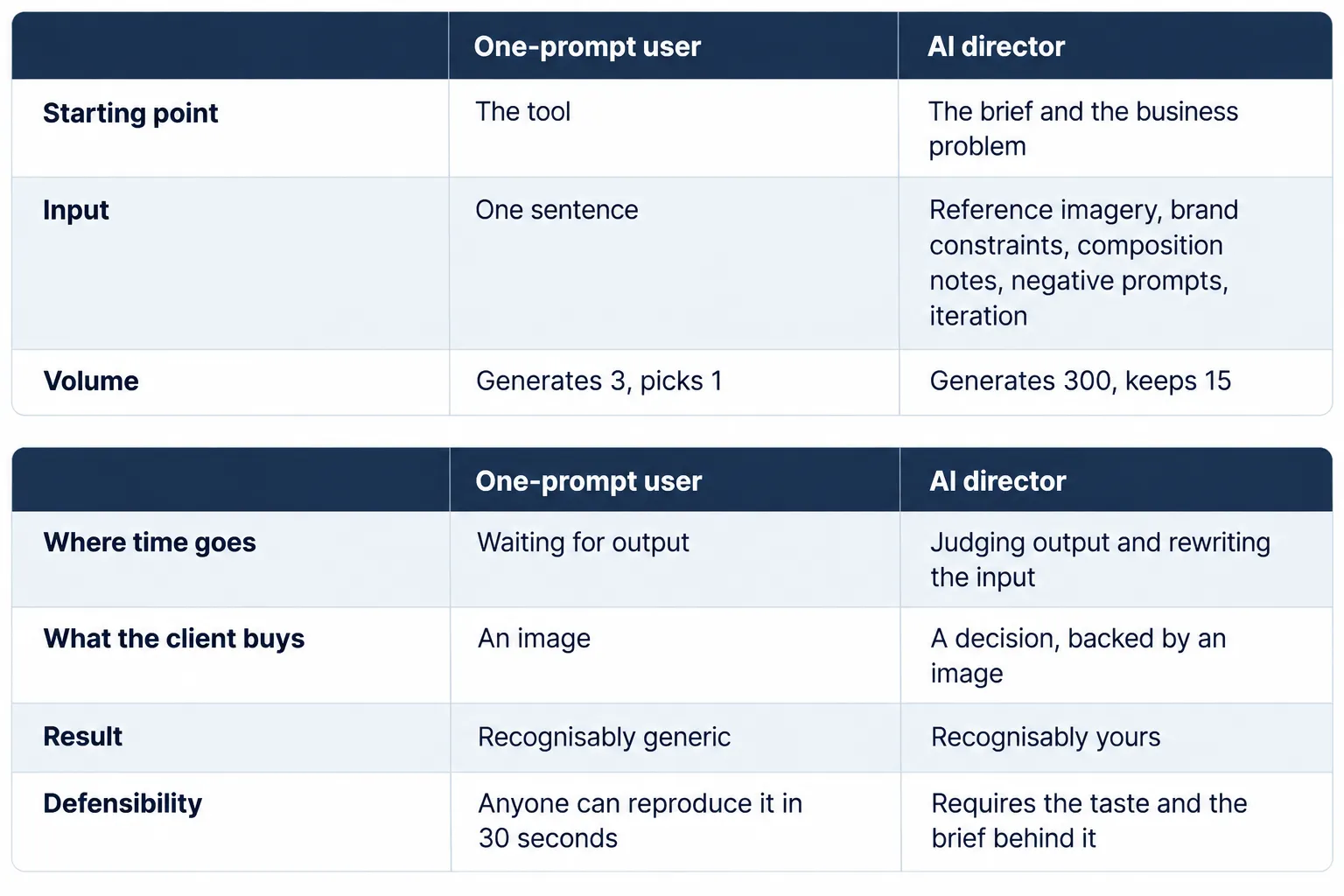
The single biggest behavioural difference is the keep rate. Amateurs accept the first plausible output. Directors reject almost everything.
What this means if you run a brand or a marketing team
Three practical positions we hold at Autofocuss, stated plainly.
- Speed is not the value any more. Judgment is. When a good render costs five minutes and five rupees, the render stops being what you are paying for. You are paying for someone who knows which render is right for your category, your customer and your price point. Hire and brief accordingly.
- Clarity of idea is now the entire bottleneck. AI removed the execution constraint and exposed the thinking constraint that was always underneath it. Teams that could not write a sharp brief were previously protected by the fact that production was slow enough to hide it. That protection is gone.
- Volume without a point of view is now a liability. Everyone can produce fifty assets a week. If those fifty look like everyone else’s fifty, you have paid to become invisible faster. The Doshi and Hauser finding is not academic, it is your content calendar.
Three questions worth sitting with
If you are a business owner reading this and deciding whether to take your creative seriously, these are the questions we ask on every discovery call, and they apply here too.
- What happens if nothing changes in the next six months and you are having this same conversation again? Your competitors will have six more months of AI-accelerated output. Some of it will be generic. Some of it will not.
- What changes for your business if you keep doing exactly what you are doing right now? If your creative already looks like everyone else’s, AI will not fix that. It will scale it.
- What is the worst case, and the maximum cost, of wasting the next three to six months before you decide to move? Usually the cost is not money. It is that a competitor establishes the visual territory you wanted, and taking it back costs multiples of what claiming it would have.
Frequently asked questions
Will AI replace graphic designers?
No, but it has already replaced a large share of the manual execution work inside graphic design. Figma’s 2025 AI report found only 31% of designers use AI for core design work like asset generation, and just 32% of respondents say they can rely on AI output. The role is shifting toward direction, curation and quality control rather than disappearing.
Why does AI-generated design look generic?
Because generative models return the most statistically probable output for a given prompt. A vague prompt returns the average of everything the model has seen. Research in Science Advances (2024) found that AI assistance increases individual creativity while measurably reducing the diversity of output across a group, which is why AI work from different people converges on the same look.
What is the difference between a graphic designer and an AI director?
A graphic designer executes a visual idea using manual tools. An AI director defines the idea, the constraints and the reference material, generates a high volume of options using AI, then selects and refines a small fraction. On the Kalshi NBA Finals ad, the director generated 300 to 400 clips and kept 15, a keep rate of roughly 4%.
How much cheaper is AI-assisted design?
The Kalshi ad that ran during the 2025 NBA Finals was produced for under $2,000 in two days using Google Veo 3, against a traditional production cost that would typically run into six figures. Cost savings of that scale are real, but they depend entirely on the operator’s skill and judgment.
Should brands disclose that creative was made with AI?
Envato’s 2026 research found 58% of creative professionals have used AI in client work without disclosing it. The commercial risk is not the AI itself, it is being caught producing work that reads as generic. Coca-Cola faced public backlash for AI-generated holiday advertising in both 2024 and 2025.
What skills matter most for designers now?
Brief writing, art direction, reference curation, taste, editing and the willingness to reject most of what you generate. Tool operation is now the smallest part of the job.
The line that matters
AI made the hands cheap. It did not make the head cheap.
Every generic AI post you scroll past is not evidence that AI cannot design. It is evidence that someone skipped the thinking and let the machine average its way to an answer. And every piece of AI-assisted work that stops you is evidence of the opposite: a person who knew exactly what they wanted, and used a very fast tool to get there.
The tool is not the differentiator. It never was.
About the author. Anirudha Kadam is the founder of Autofocuss Marketing, a revenue-driven growth marketing partner based in India, working with brands across Saas Industry offering Lead Generation Services.
Work with us. If your creative output has started to look like everybody else’s, that is a briefing problem before it is a tooling problem. Talk to Autofocuss.