
The real cost, the break-even point, and the clauses nobody negotiates.
Anirudha Kadam · Founder & Growth Consultant
12 August 2026 · 11 minute read
autofocuss.com
| £12,432
Monthly break-even between an outsourced and in-house UK team |
£185,290
True year-one cost of a three-person in-house UK team |
68%
Of UK brands already outsource a digital marketing function |
£50bn
Forecast UK advertising spend in 2026 |
Short answer: for most UK businesses, outsourcing marketing costs less than hiring for it until you pass roughly £12,400 a month in agency fees. Below that line, an external team is cheaper than a three-person in-house team once you count employer National Insurance at 15%, pension, recruitment fees and the software stack. Above it, you should be building in-house. The cost question is the easy part. The part that actually decides whether outsourcing works is who owns your ad accounts, your data and your attribution — and almost nobody negotiates that on the way in.
Outsourcing marketing is already the UK default — the question is how, not whether
There is a version of this conversation where a business owner agonises over whether outsourcing is “a real strategy.” That conversation is about a decade out of date. Around 68% of UK brands already outsource at least one digital marketing function, roughly 46% outsource a marketing function outright, and over half of UK B2B firms now run part or all of their marketing through an external partner.
The more telling number is the other end of the same market: about 20% of UK businesses that employ anyone at all have a marketing team of exactly one person. One person, expected to cover organic search, paid search, paid social, email, creative, analytics and the website. That is not a team. That is a queue with a human attached to it.
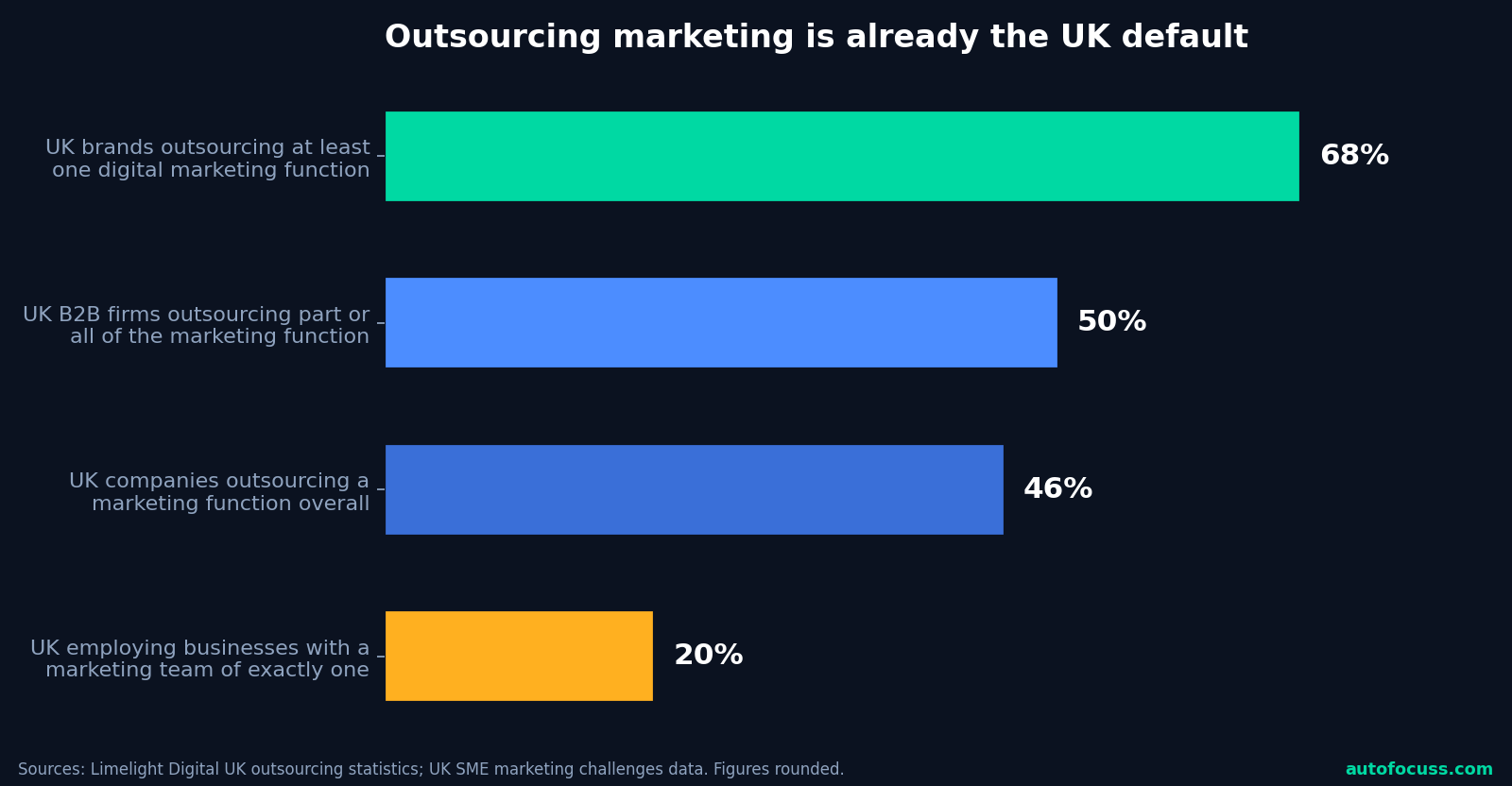
Outsourcing is not the exception in the UK market. It is the operating norm.
So the useful question is not should we outsource. It is: which functions, on what commercial terms, measured against which number. That is what the rest of this piece answers.
What does it actually cost to outsource marketing in the UK in 2026?
Indicative UK monthly ranges, based on published agency benchmarks and prevailing contractor rates. The frequently quoted average fee for a UK digital marketing agency sits at around £5,000 per month — but “average” hides an enormous spread between a single-channel freelancer and a full-stack growth team.
| DELIVERY MODEL | TYPICAL UK COST (PER MONTH) | REALISTIC SCOPE | BEST FIT |
| Freelancer / contractor | £1,500 – £4,000 per channel (£400 – £650 per day) | One channel, executed well. No strategy layer. | You already know exactly what needs doing. |
| Boutique specialist agency | £3,000 – £8,000 | Deep in one discipline — SEO, or paid, or CRO. | One channel is your entire bottleneck. |
| Full-service UK agency | £5,000 – £15,000 | Multi-channel, account-managed, slower to move. | Established brands with budget and process. |
| Offshore / hybrid delivery pod | £2,500 – £7,000 | Strong execution capacity, variable strategy depth. | High-volume production work with clear briefs. |
| Fractional growth lead + pod | £4,000 – £12,000 | Senior strategy plus execution, accountable to revenue. | You need someone owning the number, not the tasks. |
| In-house equivalent | ≈ £12,400 (steady state) | Three salaried specialists, fully loaded. | Spend and complexity justify permanent headcount. |
Two things people forget when comparing these lines. First, agency fees carry VAT — but if you are VAT-registered, that is reclaimable input tax, so compare net of VAT, not gross. Salaries carry no VAT but carry employer NI, which you cannot reclaim from anyone. Second, agency fees are an operating expense you can switch off in 30 to 90 days. A salary is a twelve-month-plus commitment with a redundancy tail attached.
Is it cheaper to outsource marketing or hire in-house in the UK?
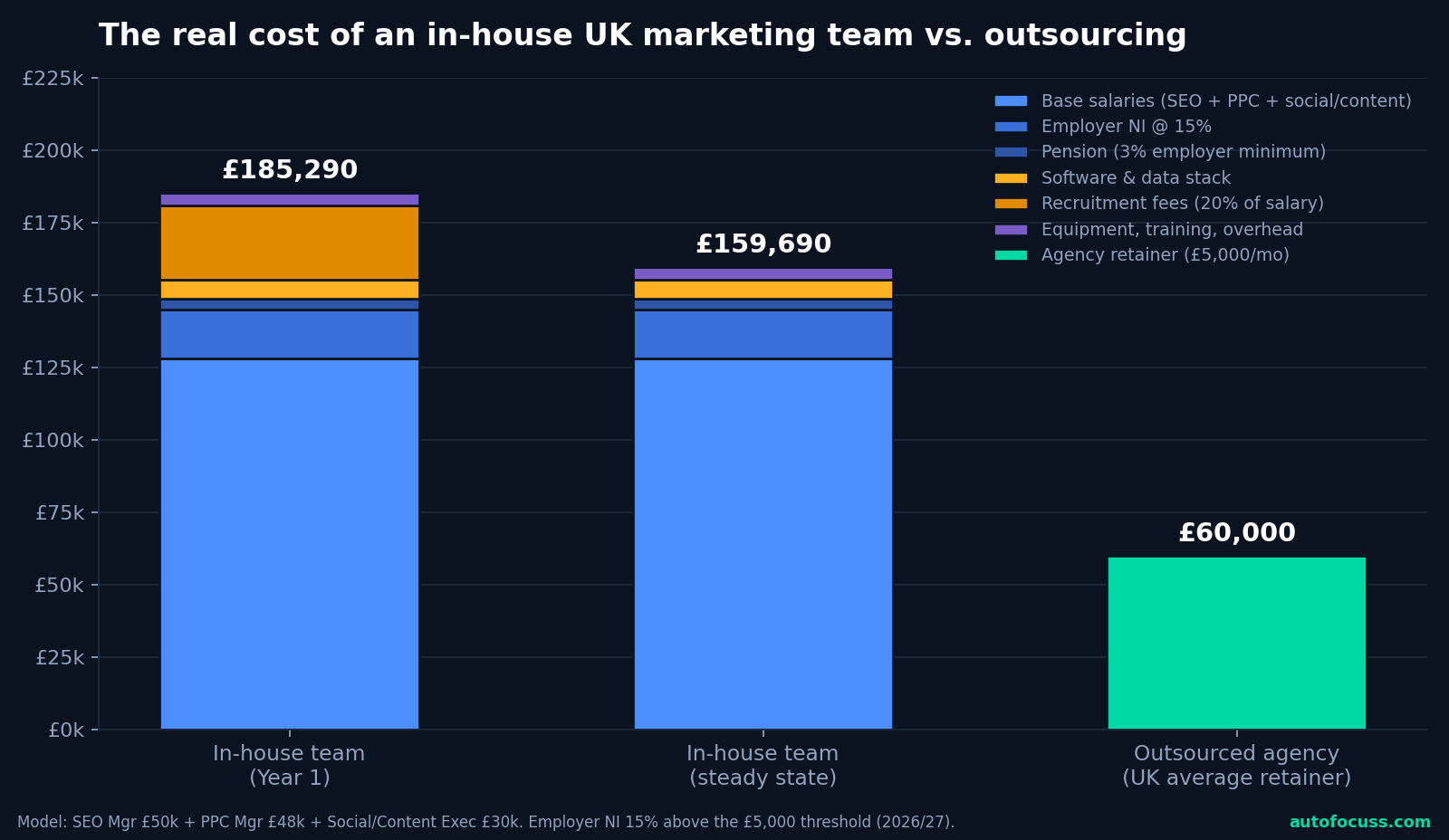
Direct answer: in the UK in 2026, a three-person in-house performance team costs approximately £185,000 in year one and £160,000 a year thereafter before you have spent a single pound on media. An outsourced team covering the same three disciplines at the UK average retainer costs £60,000 a year. The gap is not marginal. It is roughly 2.7x.
Here is the model, built on published 2026 UK salary bands: an SEO Manager at £50,000, a PPC/performance manager at £48,000, and a social and content executive at £30,000.
| COST LINE | YEAR ONE | STEADY STATE (YEAR TWO ONWARD) |
| Base salaries (SEO + PPC + social/content) | £128,000 | £128,000 |
| Employer National Insurance @ 15% above the £5,000 secondary threshold | £16,950 | £16,950 |
| Employer pension contributions (3% statutory minimum) | £3,840 | £3,840 |
| Software and data stack (SEO suite, reporting, creative tools) | £6,400 | £6,400 |
| Recruitment fees (20% of first-year salary) | £25,600 | £0 |
| Equipment, training, workspace, management overhead | £4,500 | £4,500 |
| Gross total | £185,290 | £159,690 |
| Less Employment Allowance (£10,500, where eligible) | £174,790 | £149,190 |
The salary line is the part people budget for. The other £57,000 is the part that surprises them.
The employer NI change is the line that quietly rewrote this maths. The secondary threshold dropped from £9,100 to £5,000 and the rate moved to 15%. For an employee on average UK earnings, employer contributions rose roughly 25% in a single tax year. Every UK hiring decision made on pre-2025 spreadsheets is now understated.
Where the break-even sits
Plot both lines and the crossover is unambiguous. Steady-state in-house lands at £149,190 a year after the Employment Allowance. Divide by twelve and you get the number that should govern the decision:
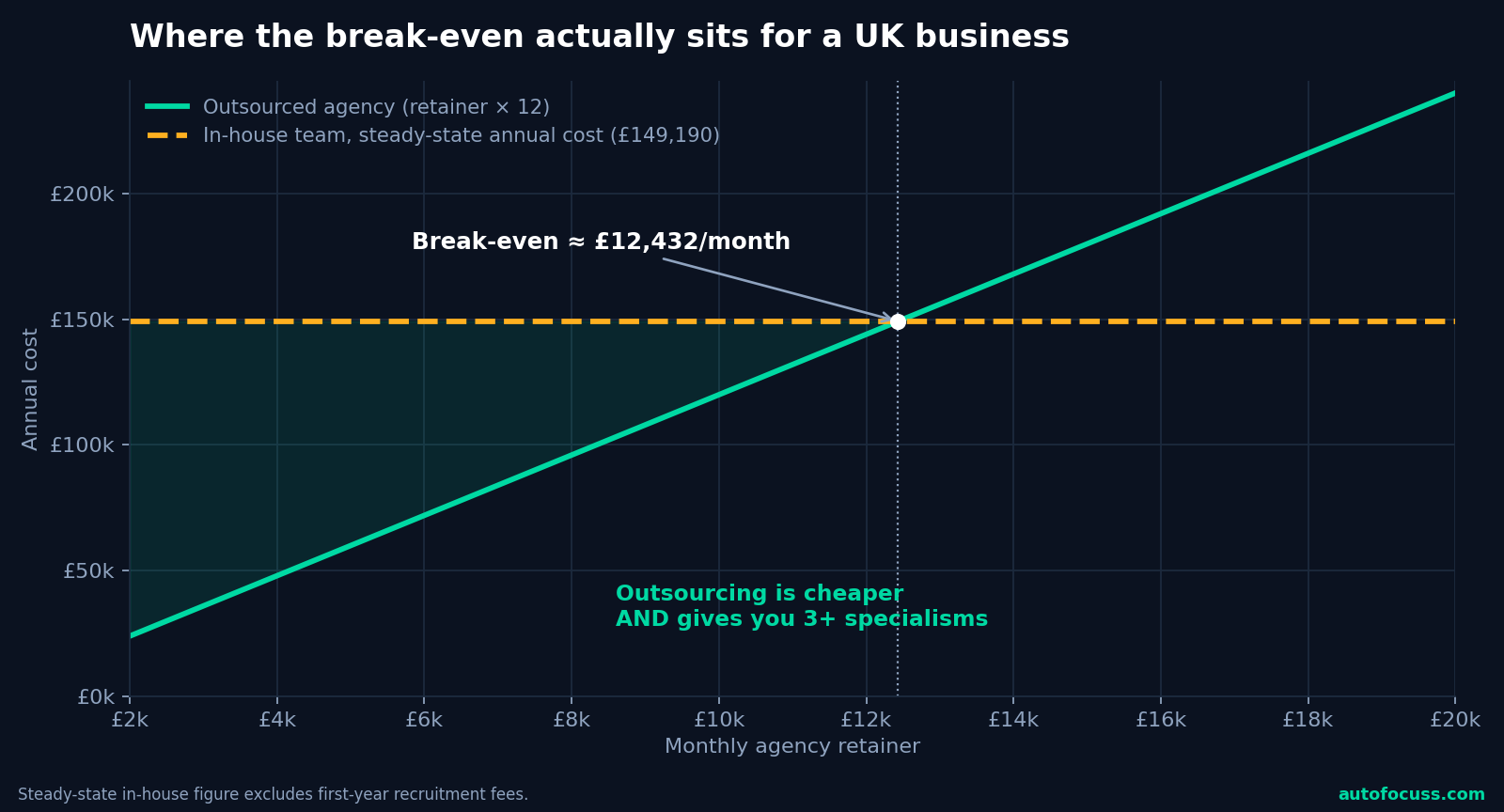
Below roughly £12,400 a month, outsourcing wins on cost — and gives you three specialisms instead of three job titles.
Below about £12,400 a month, outsourcing is cheaper. Above it, in-house starts to make financial sense — provided you can actually recruit, manage and retain three specialists, which is a separate problem with its own failure rate.
And cost is only half the comparison. £12,400 a month of agency fee buys you access to people who have run hundreds of accounts. £12,400 a month of salary buys you three people who have run one — yours.
The market you are buying into: UK ad spend passes £50bn
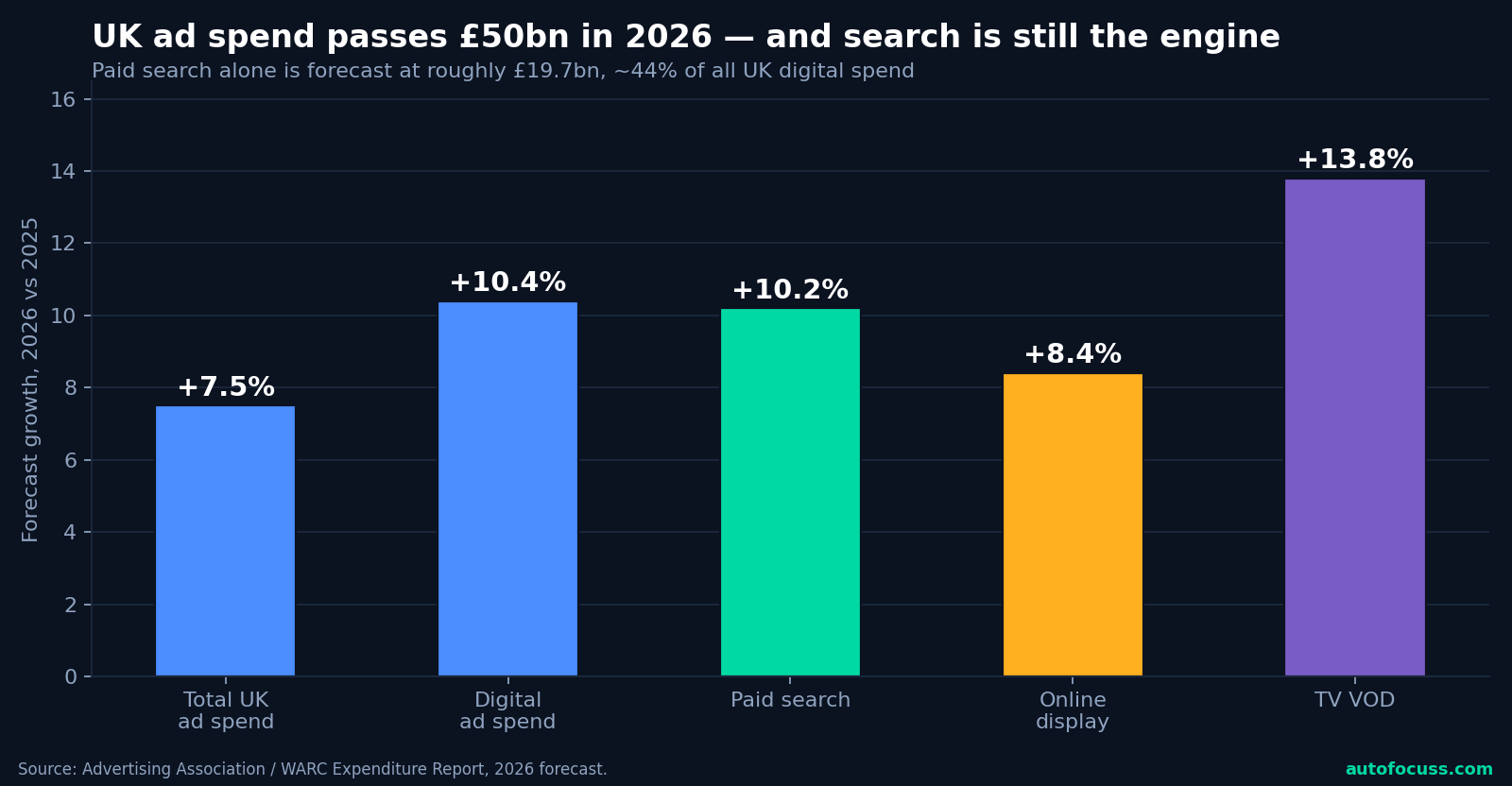
UK advertising spend is forecast to exceed £50 billion in 2026, up 7.5%, with digital formats now around 86% of the total. Paid search alone is forecast to grow 10.2% and remains the single largest channel at roughly 44% of digital spend. Online display is forecast up 8.4%; TV VOD leads growth at 13.8%.
Source: Advertising Association / WARC Expenditure Report, 2026 forecast.
The operational read on that: auction prices are rising because more money is chasing the same inventory. Rising CPCs punish undermanaged accounts disproportionately. An account reviewed once a fortnight by a generalist loses ground in a market growing at 10% a year — not dramatically, just steadily, in a way that only becomes visible when you compare this quarter’s cost per acquisition to last year’s.
What should a UK business outsource first — and what should never leave the building?
Not every function has the same outsourcing economics. The test is simple: does this job get better with volume and specialist tooling, or does it get worse the further it sits from your customers?
| FUNCTION | VERDICT | WHY |
| Technical SEO | Outsource | Highly specialised, tool-dependent, intermittent workload. Paying a salary for it means paying for idle capacity. |
| Paid search / SEM | Outsource | Improves with pattern recognition across many accounts and budgets. A specialist has seen your problem before. |
| Paid social & creative testing | Outsource | Volume-driven. Winning here means shipping many variants fast, which needs a production line, not a person. |
| Analytics, tracking & CRO | Outsource the build, own the access | Get it built properly once. Never let the accounts sit in someone else’s name. |
| Brand positioning & messaging | Co-own | An external team can sharpen and stress-test it. They cannot originate it credibly without you in the room. |
| Customer and sales feedback loop | Keep in-house | The objections your sales team hears this week are your best creative brief. That signal degrades with every handoff. |
| Pricing, offer and product decisions | Keep in-house | No agency should be deciding what you sell or what it costs. Full stop. |
What most people miss: the seven UK-specific things to settle before you sign
The cost comparison is the part everyone models. These are the clauses that determine whether the relationship survives contact with reality — and they are far cheaper to negotiate before you sign than after you want to leave.
1. Account ownership must be yours, in writing
Your Google Ads account, Meta Business Manager, GA4 property, Search Console, CRM and any tracking container should be created under your organisation’s ownership, with the agency granted access as a user. If an agency builds these under their own MCC or Business Manager, your entire performance history — years of conversion data and audience signal — is legally theirs when you leave. Agencies rarely do this maliciously. They do it because it is administratively easier. It is still your problem.
2. Data protection: a DPA is not optional, and an offshore partner needs more
Any agency processing personal data on your behalf is a processor under UK GDPR, and Article 28 requires a written data processing agreement. If your partner sits outside the UK — India, the Philippines, the EU, the US — you also need a lawful transfer mechanism: an International Data Transfer Agreement (IDTA) or the UK Addendum to the EU Standard Contractual Clauses, plus a transfer risk assessment. Ask for these by name on the first call. The answer tells you a great deal about whether the agency has done this before.
3. VAT works differently with an overseas supplier
Buying marketing services from a supplier outside the UK generally puts the transaction under the reverse charge, meaning you account for the VAT yourself rather than paying it to them. It is usually VAT-neutral for a fully taxable business, but it is not nothing on your return, and partially exempt businesses can end up genuinely out of pocket. Speak to your accountant before, not after, the first invoice.
4. Under the DMCC Act, the advertiser carries the liability
Since April 2025 the Competition and Markets Authority has been able to directly enforce consumer protection law under the Digital Markets, Competition and Consumers Act 2024, with fines up to 10% of global turnover. Fake or incentivised reviews and drip pricing are explicitly banned. The CMA has already reviewed 100 businesses on review practices and found more than half potentially non-compliant. If an outsourced team generates your review requests, your landing page pricing or your promotional claims, the exposure is yours, not theirs. Ask how they handle claim substantiation and review solicitation, and put it in the contract.
5. Agree the single number before the kick-off deck
Every outsourced relationship that fails, fails the same way: two parties optimising for different metrics and discovering it in month five. Name one primary commercial metric — qualified pipeline, cost per acquisition, direct bookings, consultations booked — write it into the scope, and agree what a bad month looks like as well as a good one.
6. Buy the ramp period honestly
SEO does not produce meaningful movement in 30 days. Paid search can produce learnings in two weeks and stable economics in six to eight. Anyone promising compressed timelines on organic is either inexperienced or selling you something. Structure the first engagement as a defined 90-day diagnostic and build phase with named deliverables, then a performance phase. It protects both sides.
7. Set the exit terms while everyone still likes each other
Notice period, ownership of creative assets and ad accounts, handover documentation, final data export, and what happens to any work-in-progress. A partner who is comfortable making leaving easy is a partner who expects you to stay.
Optimise for AI answers, not just blue links
One material change to what you should be buying in 2026. A growing share of research now happens inside AI assistants rather than on a results page, and the pattern in current citation data is instructive: brands are several times more likely to be cited by an AI assistant via third-party sources than from their own domain. Your own website is necessary but not sufficient.
Practically, that means an outsourced SEO scope written in 2023 language — keywords, backlinks, rankings — is incomplete. Ask any prospective partner how they plan to get you mentioned in comparison articles, industry roundups, directories, review platforms and trade publications, because those are the pages large language models actually retrieve and cite. Ask whether they measure share of voice inside AI answers at all. Most cannot. That is currently a competitive gap you can buy your way into cheaply.
Three questions worth sitting with before you decide
Whatever you conclude about outsourcing, these are the questions we put to every business that comes to us mid-decision. They tend to be more clarifying than another spreadsheet.
- If nothing changes in the next six months, and we are having this exact conversation again — what will have happened to your pipeline in the meantime?
- What changes for the business if you simply keep doing what you are doing right now?
- What is the genuine worst case, and what is the maximum cost of losing the next three to six months before you move?
Most businesses can absorb the cost of choosing the wrong agency. Very few have modelled the cost of another two quarters of an unmanaged Google Ads account and a website that no AI assistant has ever cited.
How to actually run the decision: a 30-day process
- Days 1–5. Write down your current cost per acquisition, cost per lead and blended ROAS. If you cannot produce those numbers, that is your first finding, and it is a bigger problem than your agency choice.
- Days 6–12. Define the one metric the engagement is accountable to, and the budget band. Shortlist four partners maximum — two specialists, two full-stack.
- Days 13–20. Ask each for a teardown of your current setup before any proposal. A partner unwilling to look at your account before quoting is quoting a template.
- Days 21–25. Run the contract checklist above: account ownership, DPA and IDTA, notice period, asset handover, DMCC responsibility, reporting cadence.
- Days 26–30. Commission a paid 90-day diagnostic and build phase, not a twelve-month retainer. Judge on what they find, not on what they promised.
Frequently asked questions
How much does it cost to outsource marketing in the UK?
UK marketing outsourcing typically costs between £1,500 and £15,000 per month depending on model and scope. Freelancers run £1,500–£4,000 per channel, boutique specialists £3,000–£8,000, and full-service agencies £5,000–£15,000. The commonly cited UK average agency fee is around £5,000 per month, excluding media spend.
Is outsourcing marketing cheaper than hiring in-house in the UK?
Yes, up to roughly £12,400 per month in fees. A three-person in-house performance team costs around £185,000 in year one and £160,000 annually thereafter once employer National Insurance at 15%, pension, recruitment fees and software are included. Below the £12,400 monthly break-even, outsourcing is cheaper and gives broader specialist coverage.
What marketing functions should a UK business outsource first?
Technical SEO, paid search and paid social are the strongest outsourcing candidates because they are tool-dependent, specialist and improve with cross-account pattern recognition. Brand positioning should be co-owned, and the customer and sales feedback loop, pricing and product decisions should stay in-house.
Can a UK company outsource marketing to an agency outside the UK?
Yes, and many do. You need a written data processing agreement under Article 28 of UK GDPR, plus a lawful international transfer mechanism — an International Data Transfer Agreement or the UK Addendum to the EU Standard Contractual Clauses — and a transfer risk assessment. Overseas supplier invoices also generally fall under the VAT reverse charge.
Who is liable if an outsourced agency breaks UK advertising rules?
The advertiser. Under the Digital Markets, Competition and Consumers Act 2024, in force since April 2025, the CMA can fine businesses up to 10% of global turnover for breaches including fake reviews and drip pricing. ASA rulings likewise name the advertiser. Contractual indemnities help commercially but do not transfer regulatory responsibility.
How long does outsourced SEO and PPC take to show results?
Paid search typically produces usable learnings within two weeks and stable unit economics within six to eight weeks. SEO generally shows early indexing and ranking movement in eight to twelve weeks, with meaningful commercial impact between four and nine months depending on domain authority and competition.
What is a realistic marketing budget for a UK SME?
Benchmarks for businesses under £10m revenue typically fall between 7% and 17% of revenue, with growth-stage companies at the upper end. Larger companies average closer to 7.7%. Fees and media spend should be budgeted separately — a common mistake is quoting one figure that has to cover both.
Where we land on it
Outsourcing is not cheaper labour. Done properly it is bought capability — access to specialists, tooling and pattern recognition you cannot justify hiring for until you are considerably larger. Done badly it is a monthly invoice attached to a slide deck full of impressions.
The difference is almost never the agency’s talent. It is whether the commercial terms were set up correctly on day one: who owns the accounts, what number the work is accountable to, and how honestly the ramp period was described.
If you are running SEO, paid search or paid social in the UK and cannot draw a straight line from last month’s spend to revenue that landed, that is the thing to fix first — regardless of who ends up doing the work.
Tell us the number you are trying to move and we will build the roadmap against it — in-house, outsourced, or the hybrid that actually fits your stage.
Cost models in this article are illustrative and built on published 2026 UK salary bands, HMRC rates for the 2026/27 tax year, and public agency fee benchmarks. Figures will vary by sector, region and seniority mix. This article is commercial commentary, not tax, legal or financial advice — check your specific position with a qualified accountant or solicitor.